The Celtic Lament
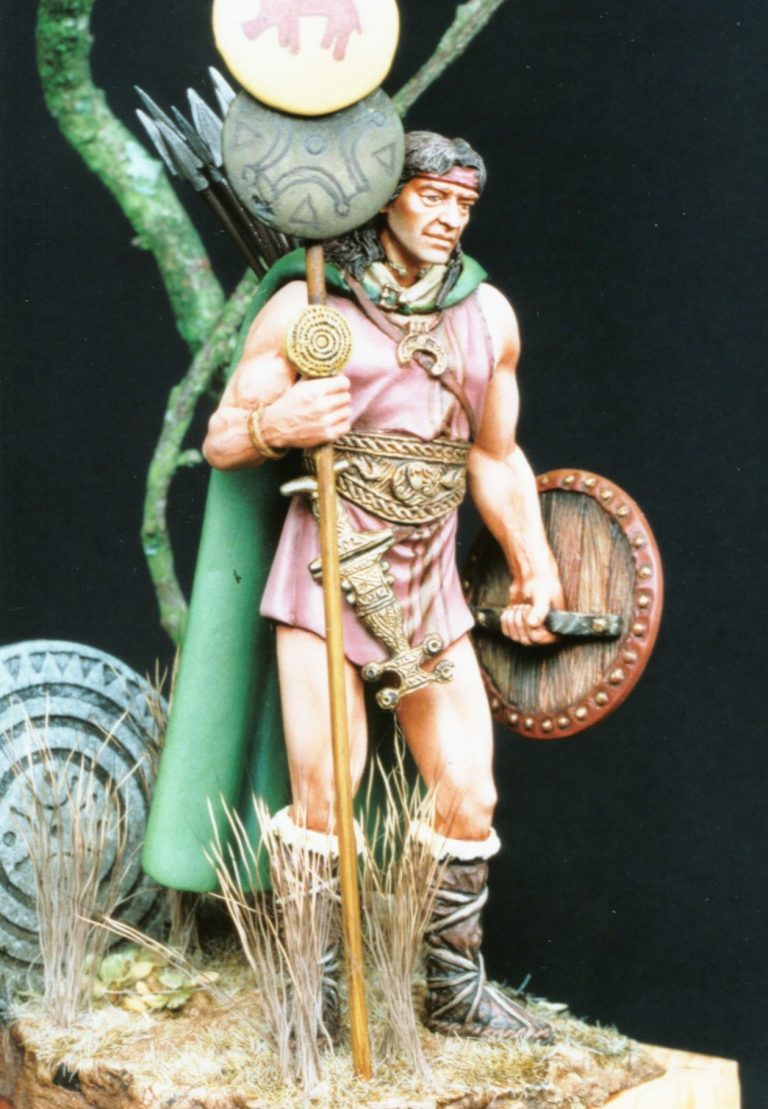
90mm white metal figure from De Tara
Painted in 2005
Before the Roman Empire flowered to its full power, the Celts enjoyed a golden age in central Europe. Their iron swords outmatched anything the indigenous populations of Britain, Spain and France had then. Even the embryonic Rome was sacked in 390 B.C. after the Celts had settled in the north of Italy in the fifth century B.C. and flexed their muscles southward.
Expansion, coupled with their martial prowess, saw them reach an uneasy peace with Alexander the Great, but after his death, the Celts soon saw fit to enter Greece and raid its cities and temples.
The Greeks were unable to stop this incursion - unlike their battles with the Persians where the Greeks won by great bravery - the Celts were a more canny foe, tending towards guerrilla warfare, feints and sudden attacks behind the Greek battle lines. The Greeks were sorely tried.
One of the Celtic warrior's strengths was the fact that the majority were mounted; noted as excellent horsemen by such reliable sources as Xenophon, the Greek general. His accounts detailed their tactics and prowess, and as a military commander and commentator of some respect, his notes can be viewed at their face value.
But then the Romans came, with their employment of the divide and conquer theory, they managed to appeal to the greed of the Celtic chieftains, having them aid the Romans, even if only with supplies, against other Celtic settlements.
This is not to say that the Romans had it their own way. Well, certainly not all of the time. It took many years of skirmishing before the Romans could even kid themselves that they'd conquered Spain.
Britain was never fully conquered, and Ireland - forget it. After expanding both on to the North African coast, and in what are now the Arab states, not to mention pushing the boundaries north into Gaul, Spain soon came under the watchful eye of the Romans. It was attacked several times, it's settlements razed, its inhabitants - when caught - killed or enslaved.
The Celts here had never actually displaced the native tribes, the Iberians, but had simply risen to positions within the ruling class, so that certainly in Northern and Western Spain, they were seen as being the biggest threat to the Empire and it's expansion.
But the Celtic people, having risen to the "upper classes" fought on, leading withering guerrilla attacks against the Roman armies, then melting into the forests and mountains. The Romans made several incursions, meeting with this almost ghostlike martial presence, fighting the mist almost, and succeeding not at all.
The Celts of Spain ( Iberia as it was then known ), were finally taken in hand by Publius Cornelius Scipio in 134 B.C.
Upon his arrival in Iberia, he was aghast. He expelled prostitutes and tinkers from the Roman army's camps, not to mention fortune-tellers, who were looked to, along with the astrologers, for any hopes of victory.
Scipio soon worked out that the town of Numantia was the most formidable Celtic stronghold, and mounted several attacks upon it, which finally ground down into a long running siege; sixty thousand Romans to keep approximately one tenth of that number of Celt Iberians at bay. It would have been a joke if the stakes hadn't been so high.
Eventually the town leaders went to the Romans under a flag of truce, their leader - Avarus, sued for a settlement. But by this time Scipio was interested in only complete capitulation, having just returned from one of the neighbouring settlements - Lutia - having put paid to their aiding Numantia by having 400 Celtic warriors hands removed. Avarus returned with his band of followers, only to be killed soon after amidst fears that he might have made a private deal with the Romans for his own safety.
Numantia eventually surrendered, and this broke the back of the Celts resistance. They never truly gave up to the Romans, there were still many uprisings, and Spain was never truly annexed in the same way that other countries were that border the Mediterranean. But there was never a decisive onslaught made upon the Roman invaders that would expel them for good, until hundreds of years later when the Empire was in its decline.
Having said that, the Romans only ever seemed to settle on the coast, leaving the mountainous interior of Spain to the Celtic warlords. These lords however did pay homage to Rome, but it is they and not the Romans, who countered the incursion of the Germanic tribes of the second century B.C.
The Cimbri received rough treatment from the Celts of Iberia, and were eventually repulsed, their tactics being too similar, and the Cimbri, along with their Tutone allies returned to harass northern Italy once more.
The model.
This is a white metal kit from the Spanish based company of De Tara.
Arriving in a large-ish box, well shielded from the hazards of travel with bubble wrap are two resin and twenty white metal castings that go to make up this 90mm tall figure.
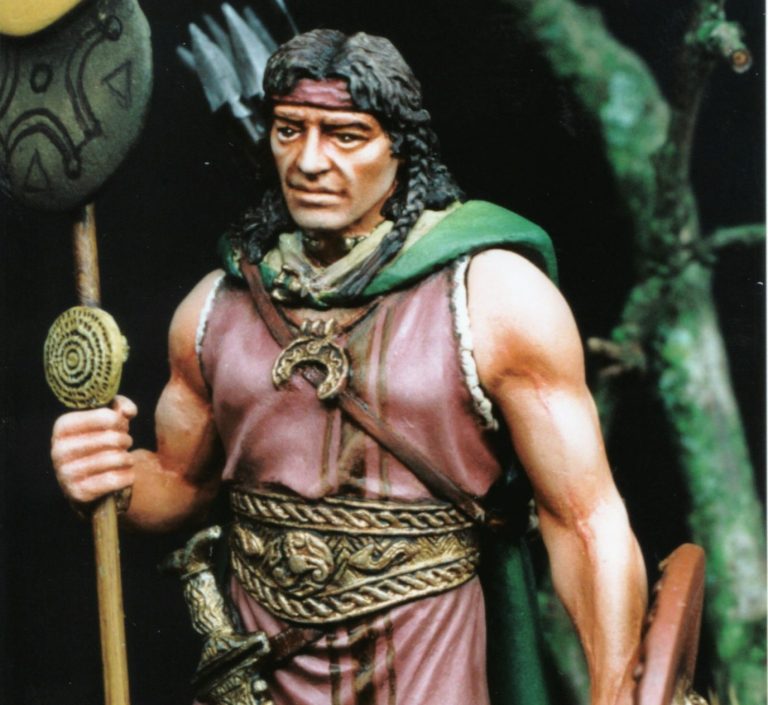
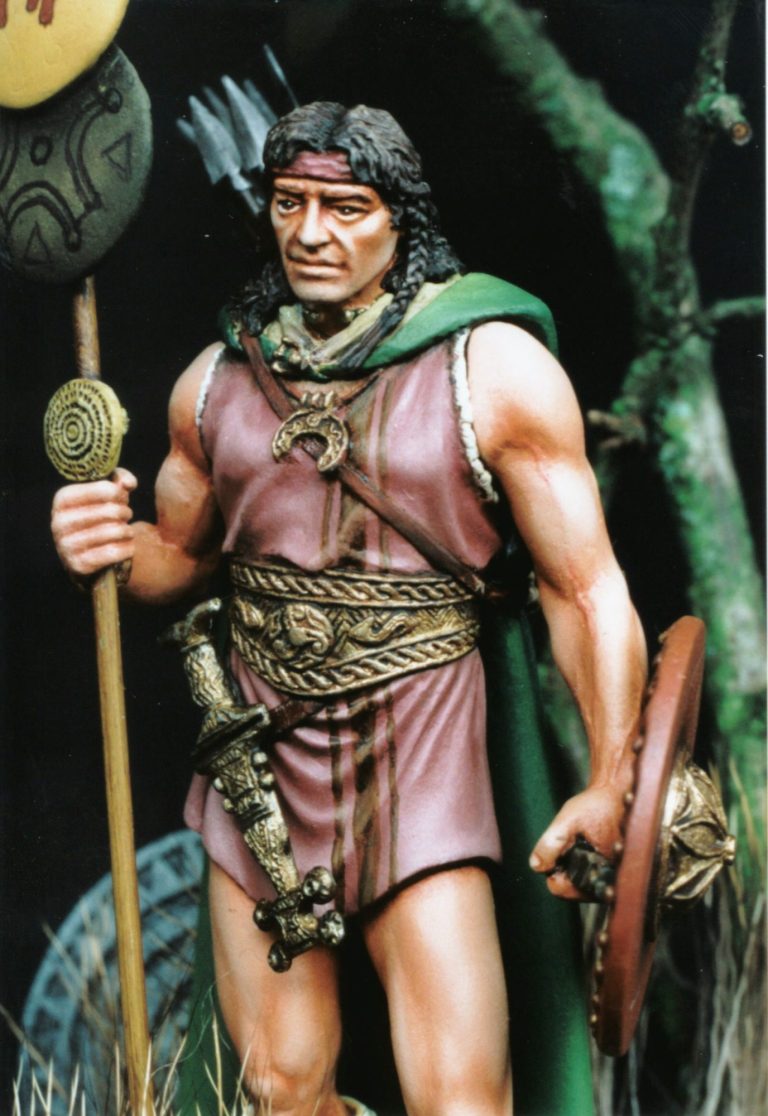
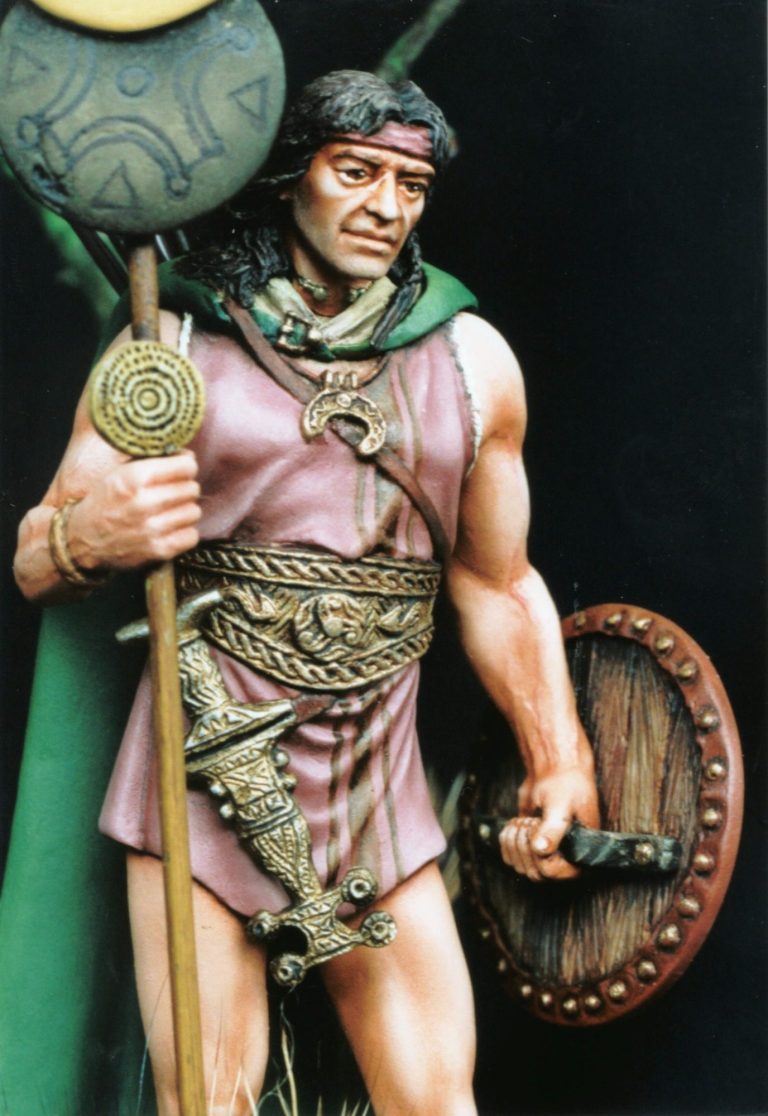
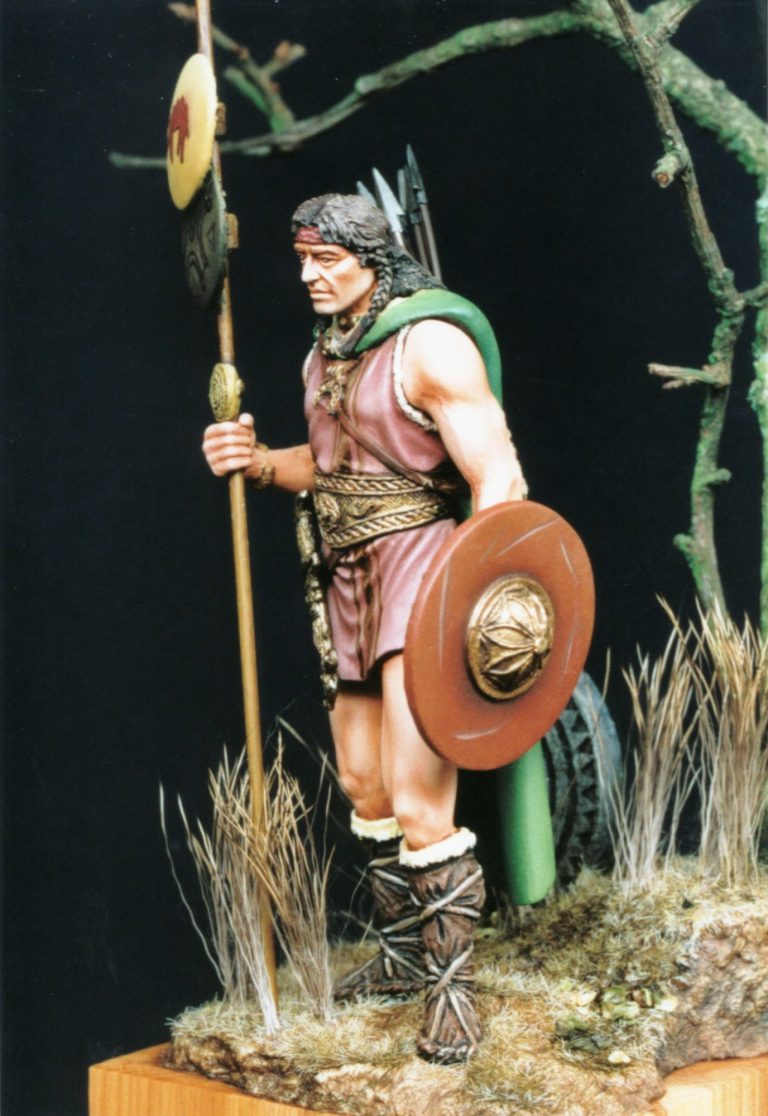
It's a straight up and down pose that has an introspective character; one that I felt gave a hint of the constant skirmishing that the subject probably had to deal with.
I don't really like these inactive poses, but seeing the initial castings for this model at Euro 2001, my interest was certainly caught. Maybe it's the facial expression, I don't know, but when it arrived though the post, I couldn't wait to paint it.
Clean up was very easy. The material used is a particularly soft white metal, one that makes your fingers silver after working on it for a short time. So I'd suggest gloves if you've got skin that reacts to this kind of stuff, and at the very least a good wash of the old mitts after handling it is essential.
The parts clip together easily, and I found that the only filler that would be necessary was for the cloak to shoulder joint and also for disguising the line where the basket on his back meets the cloak. The arms, head and lower torso/legs all fit seamlessly together, positive keying surfaces making the joints very strong.
There were no problems with assembly, although I chose to leave the upper and lower body separate, the arms too and head were only joined to the sub-assembly of the cloak and upper torso once all the paint was on and dry. I did add some lead wire around the steel rod that is supplied for the standard. I felt that this was needed for the point just below the capping pig's head emblem, and this was the only addition that I made to the model.
With the model cleaned up, and the parts I'd chosen to glue together dried; I primed the metal with a thin coat of Games Workshop Skull White.
As usual I painted the face, arms and legs first, beginning these with an undercoat of Humbrol Flesh with a little white added to it. A second coat of this was added once the first one had dried fully, and then after another couple of hours drying time, I could begin with the oils.
I mixed up my preferred base colour using Winsor and Newton (W&N) Flesh Tint, adding some Yellow Ochre and Titanium White to this to take away the "pinkness". This mix was then painted onto all the flesh areas, and then stippling it with a larger, dry brush to take off any excess accumulations of paint.
Small areas of shadow were added by spotting on Burnt Sienna ( W&N ) and then blending this in to the surrounding base colour with a clean, dry brush, again using a stippling action so that an even surface texture is maintained.
Shadows can be strengthened by adding more Burnt Sienna, but it will eventually get to a stage where the additional paint will have no effect, and it's best to stop before that happens, continue by adding the highlights and then add further shadows with Burnt Umber which is a much darker brown, once the initial oil paints have had chance to dry fully.
The highlights as mentioned, are added whilst the base mix is still wet, and the paint used is Titanium White ( W&N ). This is a very strong white, so only small amounts need to be added to effect a colour change. As with the shadows, more spots of white can be added to strengthen a highlight, and once the paint is dry, further additions of white can be made - this time in the form of localised washes, thinning the paint with White Spirit, and blending it into the surrounding area.
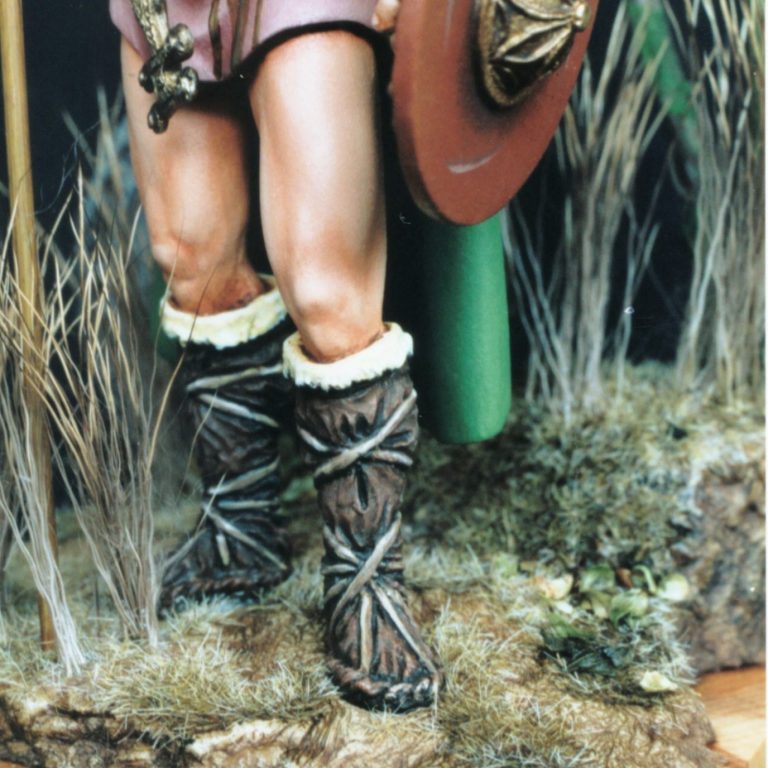
With the flesh tones finished, I moved on to paint the boots. Initially I thought I'd made a right mess of these. I painted on thinned Mars Black ( diluting it because I wanted to add lighter colours over it, and whilst I wanted to blend the colours together, Mars Black is such a strong colour that I needed very little of the stuff to be there ). I added Vandyke Brown ( W&N ) to this, and I kept having problems with the white primer showing through. Eventually, after having pratted about with this for several minutes ( I didn't say I was patient, did I ? ), I added more of the Vandyke Brown so that the black was completely overwhelmed.
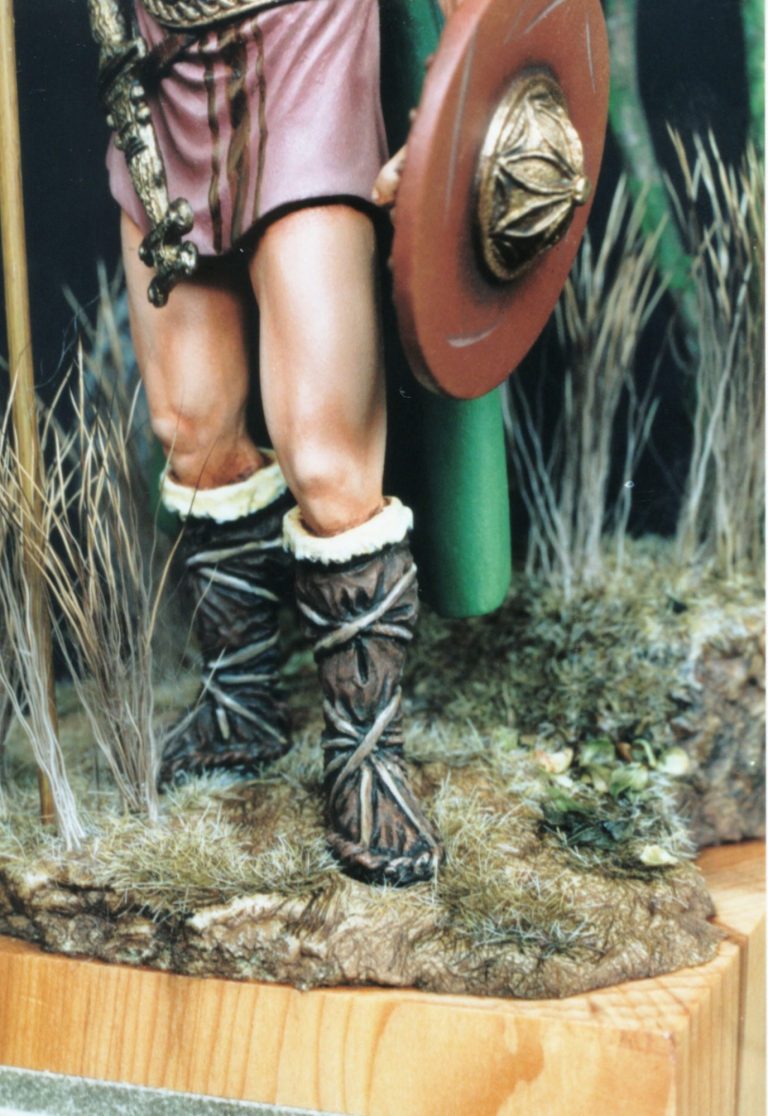
Leaving this for about an hour ( A calming brew of tea, and a quick kick at the cat to occupy the time ), and I returned to add some Mars Brown to the leg wrappings. Then to that was added some Yellow Ochre and finally some white. For the straps, which I took to be leather, but I suppose could just as easily be cloth, I left out the Mars Brown, adding just the Yellow Ochre
and the White.
It still looked a mess though.
Hmmm.
Out with the Mars Black again, and I used this, not thinned quite so much this time, to add outlines to the leather straps and some of the deeper shadows. For some stupid reason this lifted the whole effect from "Ughh" to "Hmm, not bad."
It looked O.K. even when it had dried.
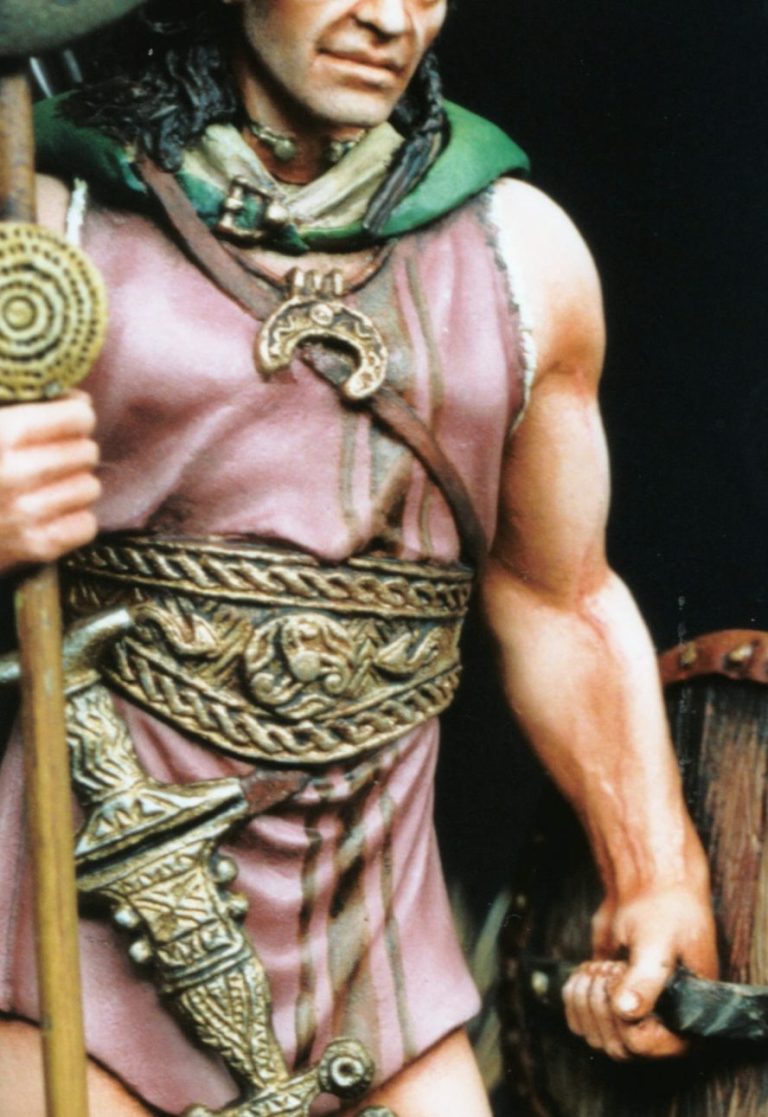
Moving on, I then painted the shirt ( could this be classed as the chiton ? ). Looking for something different, I began mixing acrylic colours a little Humbrol Crimson, some Skaven Brown, a little Skull White ( Yes the latter are of course the Games Workshop colours - but you knew that didn't you ?). I ended up with a pinkish colour, which was like a very much-faded red.
I liked it; it was different. So it was painted on to the model. Only one problem of course - I needed to mix up a similar oil colour.
This wasn't too bad, beginning with Alizarin Red, adding a little Burnt Umber, and then some Titanium white, a dash more of the Burnt Umber and a little bit of the Mars Black just to "grey" it off a little.
This mix was then added to the model in a similar manner to the base colour on the flesh areas. I used a shadow colour of Burnt Umber and Alizarin Red, and highlighted with more white. Again these colours were blended in using a clean, dry brush.
The belt gave me a bit of a dilemma. Would our down and out looking Celt not have traded such a grand object for some better clothing?
I decided to give the belt an old look, simply by mixing some Olive Green ( W&N ) into the Testors Gold enamel. A few highlights of pure gold, and once fully dry, a spot wash to the deeper detail using thinned Burnt Umber. The sword in it's scabbard was given the exact same treatment, the back being painted a darker gold ( more green added ) and faded into black.
This was allowed to dry, and then glued in place on the model after the upper torso was fastened in place - but there's a lot more painting to do before the glue can be brought out.
The other belts holding the sword and the javelin ( or darts ), were both treated as leather items and were painted in a similar manner to the leg wraps. I added some Yellow Ochre and Titanium White to the edges in a random manner, hinting at the leather being cracked and well used.
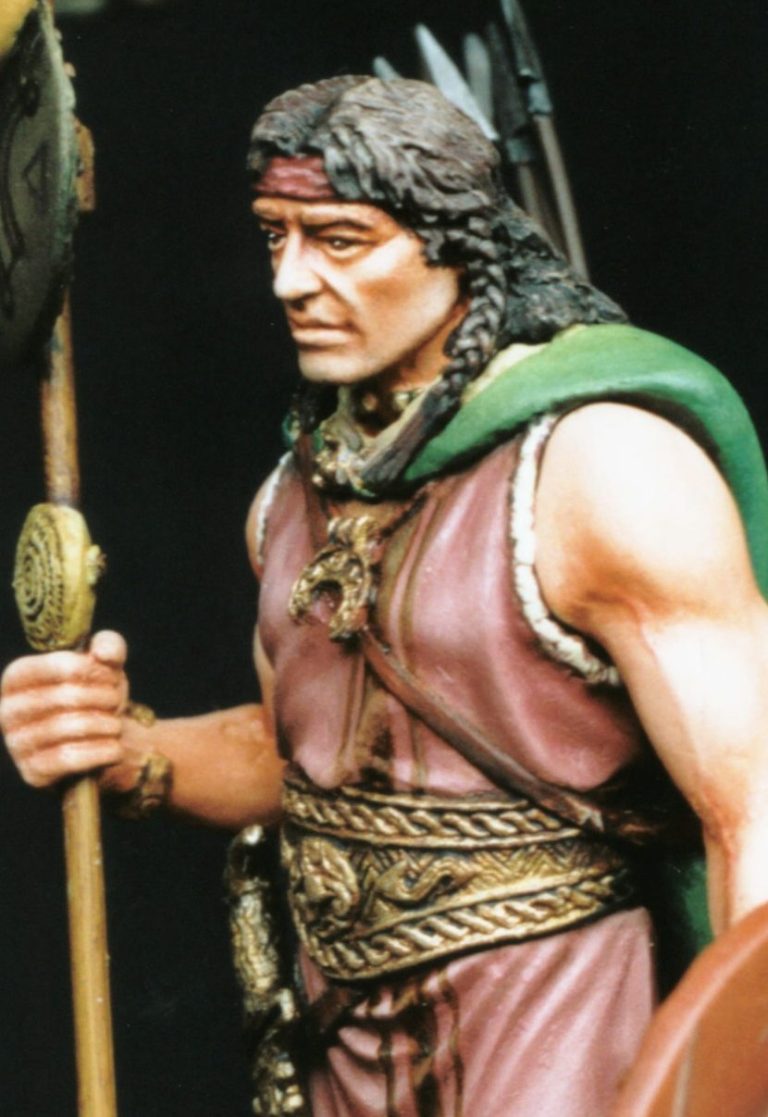
For the cloak I began with two flat colours, a linen or unbleached wool for the outer face, and a green for the inner face, again picking colours that would be readily available as dyes or natural material at such a period in history.
I did the linen colour first, using an undercoat of Orc Brown ( GW ) acrylic, over which a mix of Yellow Ochre and Raw Umber were painted. This was then highlighted with more of the Raw Umber, and a mix of Yellow Ochre and Titanium White used for the highlights.
The green was again a GW acrylic undercoat, this time a mix of Skull White and Forest Green. On top of this was painted a mix of Yellow Ochre and Prussian Blue, this being shaded with a mix of Mars Black and Prussian Blue, and highlights from Titanium White. This was allowed to dry thoroughly; then I painted in the basket using an undercoat of the Orc Brown and several washes of Burnt Umber oils. This took time to dry, but after a very light dry brushing to pick out the highlights with Yellow ochre, it was worth it just to see all that detail brought to life.
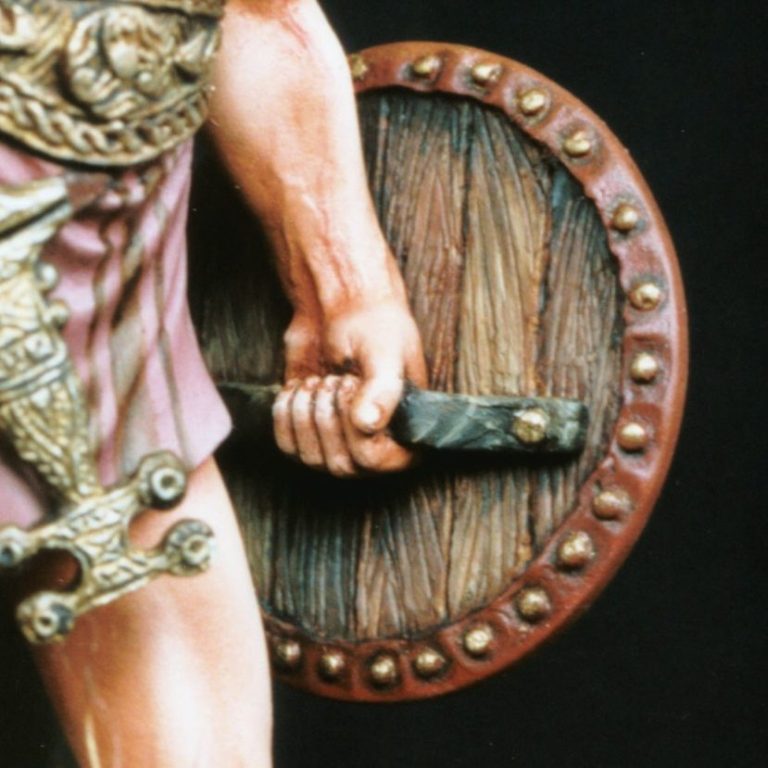
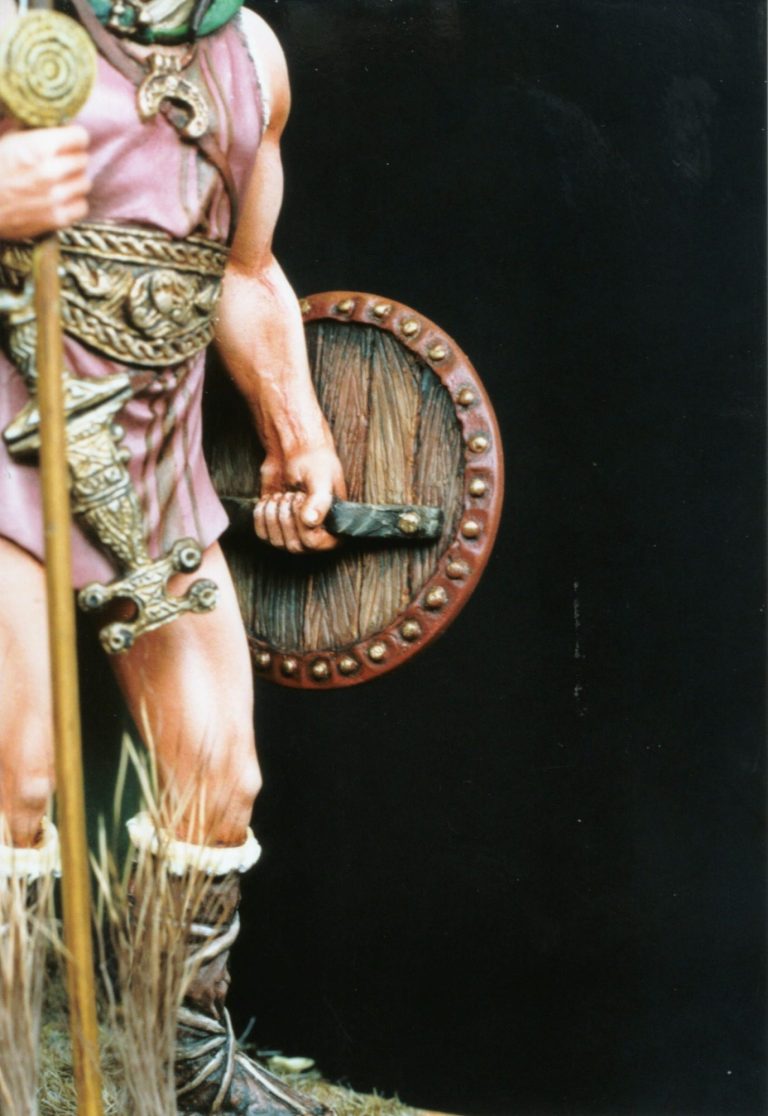
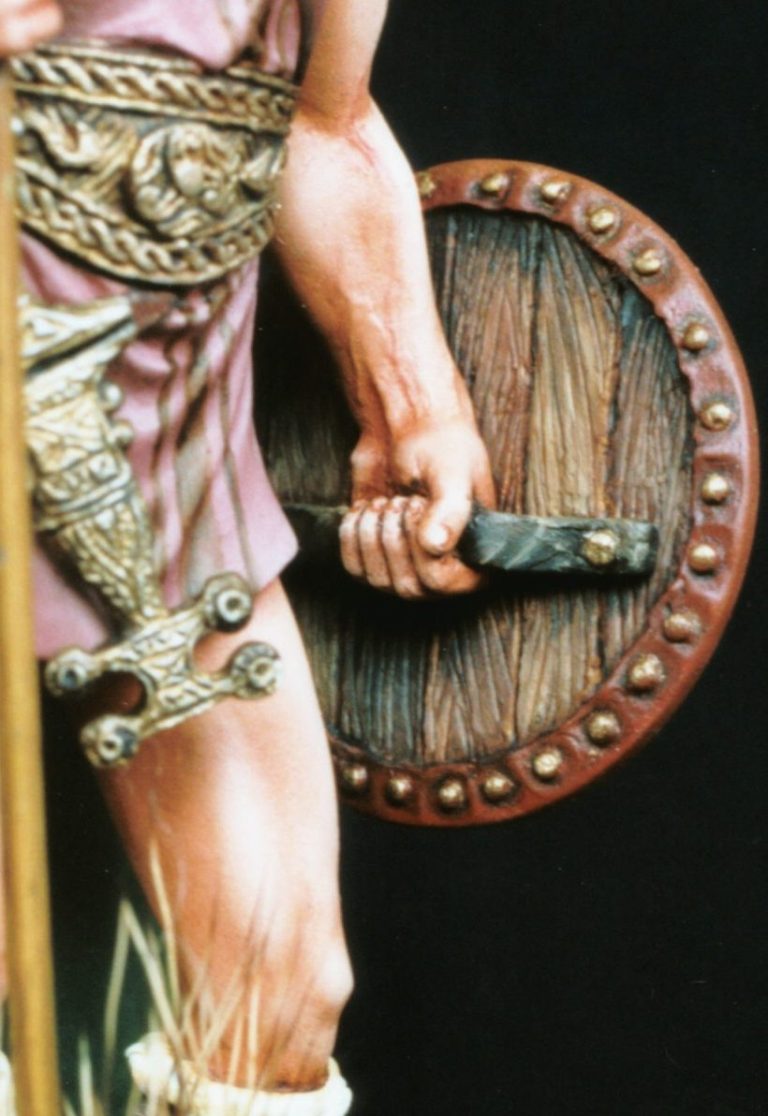
Whilst I waited for the paint to dry on these parts, I occupied myself with the shield. This was undercoated in GW Swamp Brown, and then over-coated with Burnt Umber ( W&N ), followed by blending in Mars Brown ( W&N ) and a little Light Red ( W&N ). I added the scuffs after this had dried by making thin lines of Yellow Ochre / Titanium White with a line of Burnt Umber directly above them.
The wood detail on the reverse was painted with various brown washes to pick out the detail, and the boss and nails were painted with a bronze mix made from Testors Gold enamel, Olive Green and Mars Brown. This was given some subtle highlights of gold.
With the cloak fully dry, I began to add a pattern on to its outer face. I wanted something fairly simple and opted for a design that hinted at an early plaid.
I began by adding a line of Burnt Umber oils parallel to the bottom edge of the cloak, concentrating on getting the bottom edge straight. Then, once I was fairly happy with that, painted on a second line above it.
This time I concentrated on getting the upper edge of the line, which faced away from the first line, as straight as possible.
Then I simply filled in between the lines with more of the dark brown, creating a thicker band with ( hopefully ) two straight edges.
This looked a bit too "drawn on", so I used a brush dampened with a little white spirit to go along the edges and smudge the line a little, giving a woven wool appearance.
Now for the tricky bit. Two more lines, this time quite thin ones were added above and below the thick band. Again these were smudged a little with the dampened brush.
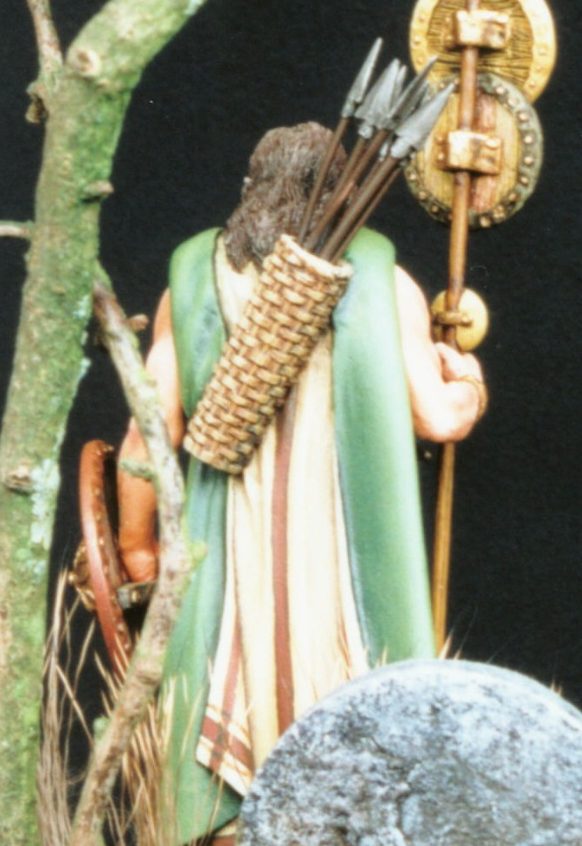
After this, I added a thin line running down each of the visible edges of the cloak, and also one running down the centre of the back.
This looked O.K. but was further enhanced by adding some Mars Violet to pick out the highlights on each of the bands or lines.
Whilst this dried, I painted the javelins. These are simple affairs, the wooden staves being a brown colour and the metal heads being bronze. I thought that maybe iron might be a little too expensive for a disposable weapon of this type, not only that, the bronze adds a little more colour, keeping most of the metalwork gold in nature.
With the cloak dry, I glued the upper body to the legs and lower torso, and then added the arms and finally the head.
Because I'm a little awkward, and I like my models to be just a little different, I tipped the head a bit more forward, giving the model a more introspective, downtrodden air. This meant that I had to add a little filler to the hair, sculpting this in to match the moulded item, but the process didn't engender any difficulty. The fit of the parts if left alone requires no filler by the way.
Once the filler was dry, I painted in the hair, going for a base coat of Mars black, followed with highlights of Mars Brown working through this to yellow Ochre and white. I painted the plait separately to the main mass of hair, bending and gluing it in place once it was dry, and then touching up any damaged paint after the glue had set.
The staff and small shields were painted with an Orc Brown and Forest Green acrylic respectively, and then oil colours were added. The yellow shield beginning with Yellow Ochre, highlighted with Titanium White and shaded with a little Raw Umber.
To get the green, a mix of Olive Green and Mars Black was made, adding some Yellow Ochre to this to build up the highlights. The designs were applied afterwards, using an undercoat of Skull White acrylic so that the oil colour wasn't masked by the dark green.
The shaft was painted with some more of the Orc Brown, adding a coat of Burnt Umber to this and then removing most of this latter colour with a stiff bristled brush. The stiff bristles move the paint about more than removing it from the staff, and thus give a fair approximation of wood grain.
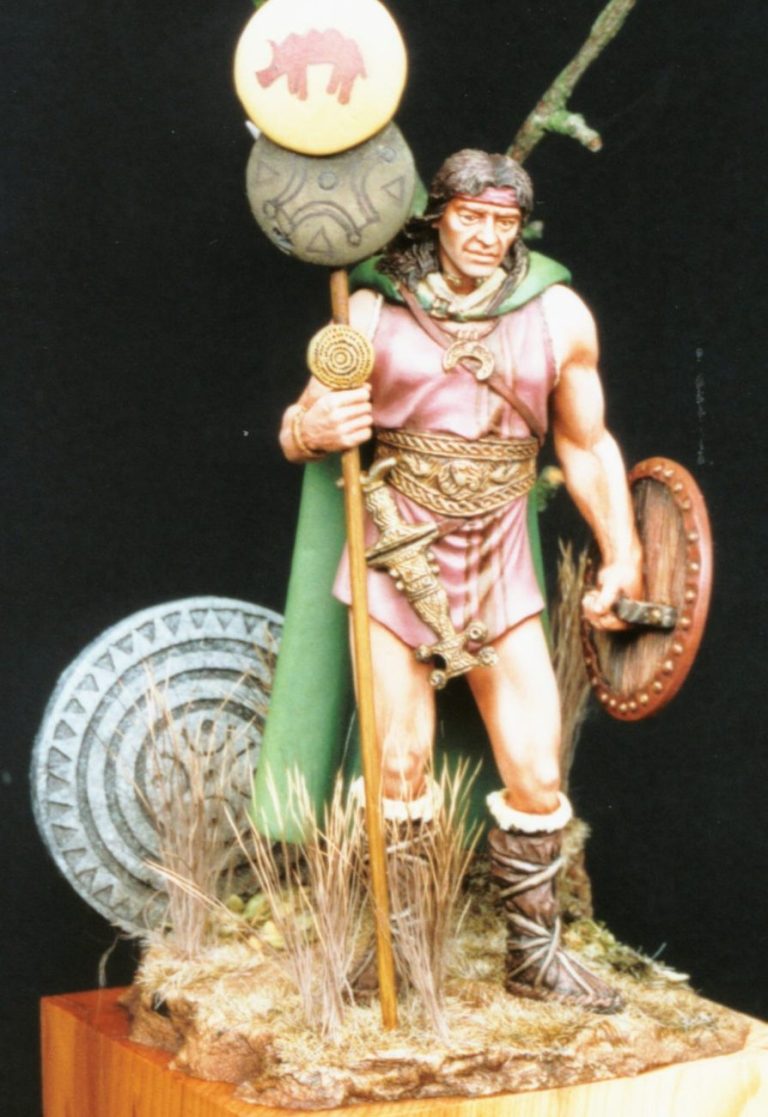
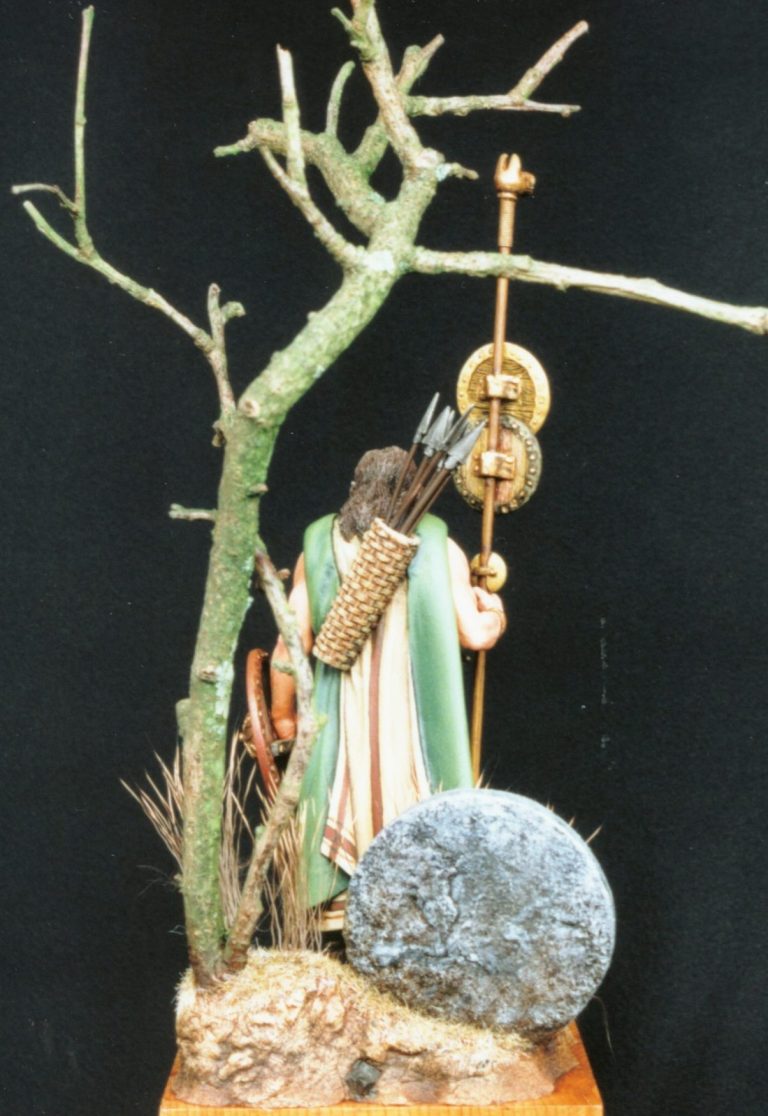
Now the base.
Using a wooden Plinth from Armstrong Bases, I added Milliput to the top of it to rough out the groundwork, building it up at the back of the base where eventually a tree would be added, made from an off-cut from a handy tree in the garden.
I textured the Milliput with a small stone, pressing this in repeatedly to leave its imprint in the putty, and using it to form the desired shape to the groundwork. I also used an old hobby brush - the ones with the plastic bristles - to give texture to the putty where a path would cross the groundwork.
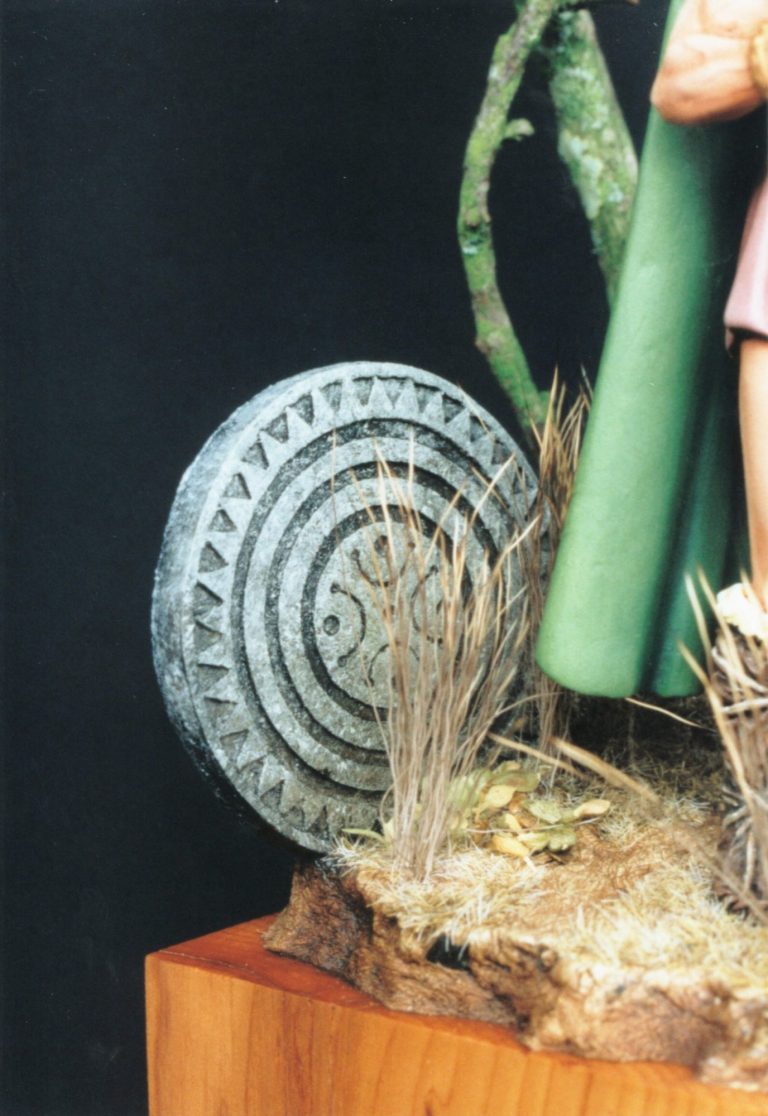
Then I added the tree, checking that it's branches wouldn't foul the standard, and also added the resin "stone" marker that comes with the kit.
The figure was also pressed into place, wetting the lugs on the bottom of the feet so that the Milliput didn't stick to them. The figure was then removed and put to one side.
After the Milliput had dried, I added Burnt Umber oil paint to the groundwork, wiping most of the paint off with an old T- enough of the paint on to pick out all the textured detail.
Again the base was allowed to dry, then Static Grass was fastened in place using white woodworking glue, this being painted once the glue had dried so that the Static Grass was changed from it's pale brown form to a more natural green colour.
Final additions of leaves from Hudson and Allen and also some deer hair for the longer grass, and also a nameplate finished the base.
The last addition of course was the figure itself, slotting this into place in the indentations made in the Milliput.
Final words
Well that's it. Another nice little kit painted and assembled.
I found this a very enjoyable little project. It's one of those nice ones that comes along every now and then and almost falls together in front of you. There's no real effort involved.
I think what I'm getting at is that it was a relaxing experience. No whittling away at components, no twisting to fit having thought that sub-assemblies would join O.K.
Yes, it's been a pleasure to paint.
The sculpting is good, production is excellent, and the subject is one that seems to be popular at the moment. I must admit to having been tempted to add a horse, removing the standard to loop the reins through that hand. A simple alteration, and a whole different look would be gained.