Falls the Shadow
A reproduction in miniature of an instalation at Passchendale Museum
Constructed in 2026
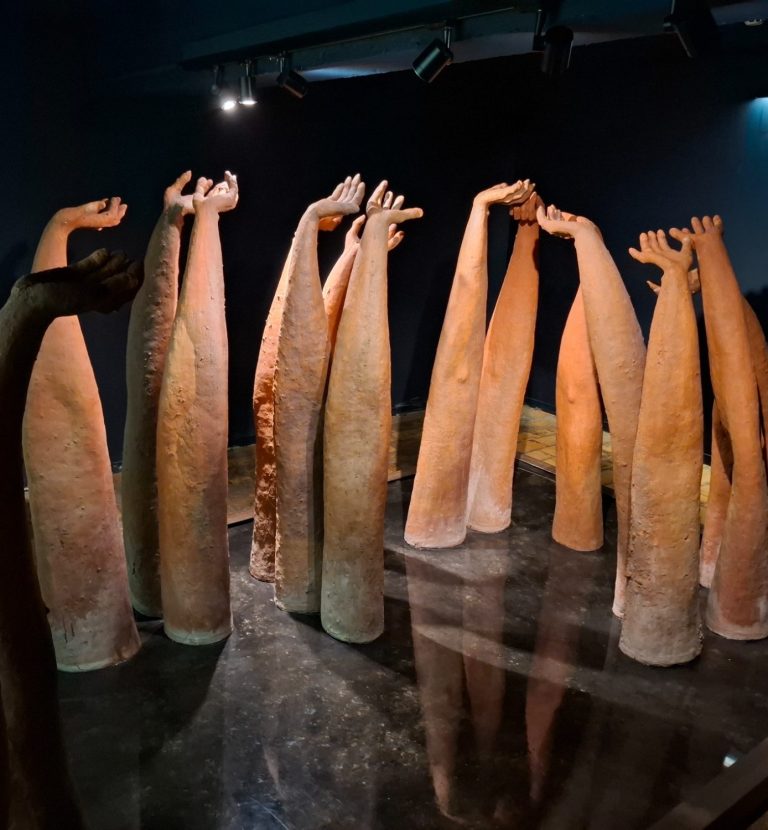
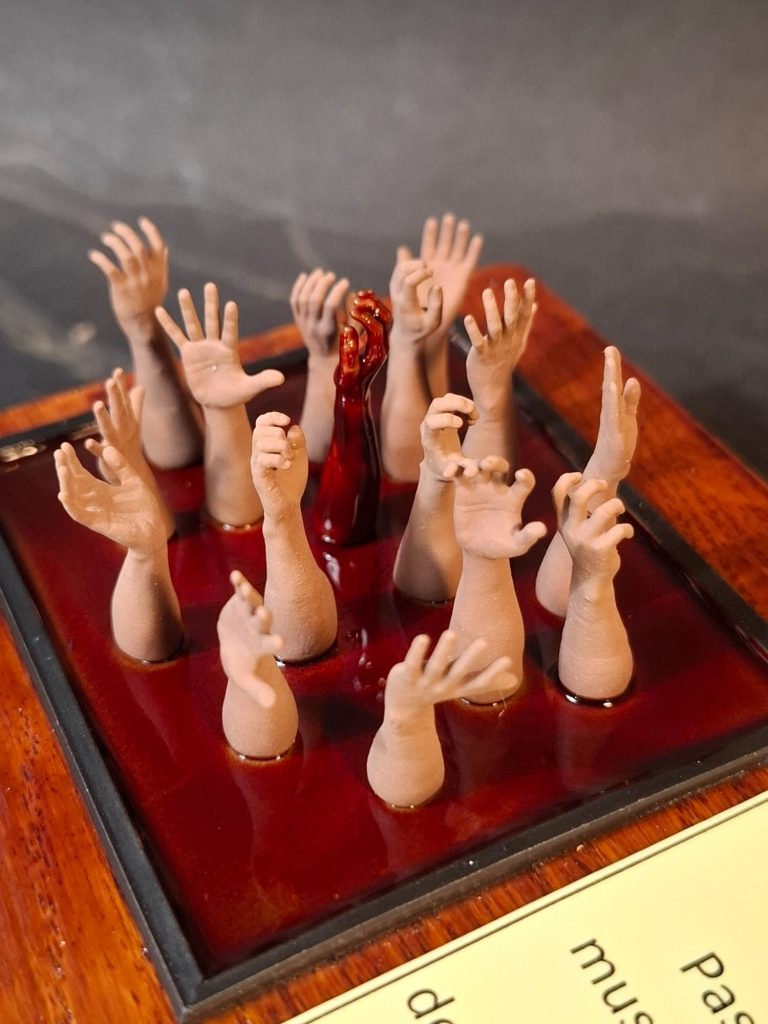
On a visit to the Passchendale museum I was particularly moved by an installation there made by New Zealand artist Helen Pollock and shown in photo #1
It is dedicated to the men who fell injured and subsequently drowned in the pits and shell craters on the battlefields of World War One.
The elongated arms with hands outstretched calls to the imagination of the cries from these men as they were slowly engulfed by the thick, oozing mud and stagnant water laced with noxious elements from the explosion of munitions, not to mention the remains of the dead already lodged within those same pits.
It’s not a nice thought, and I have to admit that my mind formed images that I’d rather not have had.
Whilst I could imagine the mechanics of what happened, I cannot say that I could really know the terror and anguish of the reality.
The sculpture provoked both my imagination and my feelings.
Far from disliking the installation, I admired it for it’s ability to give me those thoughts, and afterwards, discussing it with my son and the four friends we were with, it seems that all of us were affected by the installation.
It made me admire it even more.
As modellers, I think we get inspiration from many sources – pictures, books, comments or even ideas proposed ( sometimes unknowingly ) by others, sometimes even a challenge set by a third party.
This sculpture however, made me think. Maybe I should try and repeat something similar in miniature.
Initially I thought of making it in 1/35th scale, and set about sourcing some sets of hands in that scale. However, having bought a couple of sets, and although they were excellent, my rendition of the original would appear much too small. It would look lost, or probably be overlooked.
The biggest scale that sprang to mind was of course 1/16th scale, or 120mm if you prefer, and I found a set of sixteen pairs of hands from a source in Germany called Tusk models and offering the set as 3D prints in several different scales.
Not cheap at £38 for the set, but it was the only option available, rather than buying separate hand sets and really racking up a greater cost.
The hands come still attached to their supports, although this is good because there are four strong “posts” at each corner of the rectangular base that protect the delicate outstretched fingers in transit.
So, no breakages, and a bit of careful cutting after heating the resin up in hot water for a minute or two gets the hands off the support structure.
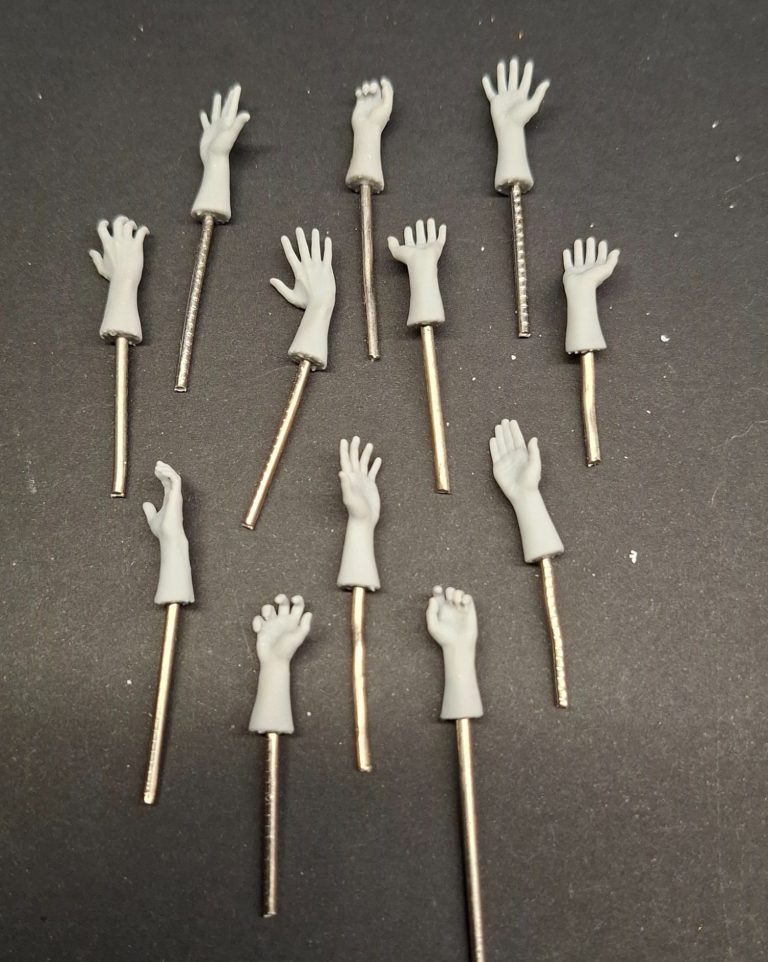
Shown in photo #2 are the hands I selected for the model, several different poses of the fingers, which took me away from the original installation sculpture, but that suited me fine.
The replacement hands all end about half way up the forearm, so I’d need to lengthen these a little, although I didn’t want to have them as elongated as the Helen Pollock sculpture.
So I drilled into the ends of the forearms and inserted short lengths of wire to act as a skeleton for the putty that would need to be added.
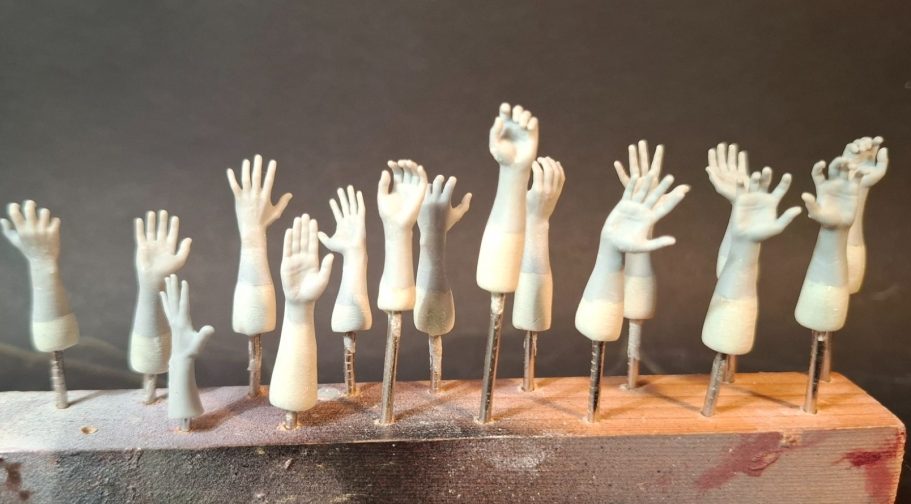
Photo #3 shows the hands having been lengthened slightly with the addition of Magic Sculpt putty, and set into holes drilled into a length of wood so that I could hold them whilst being airbrushed.
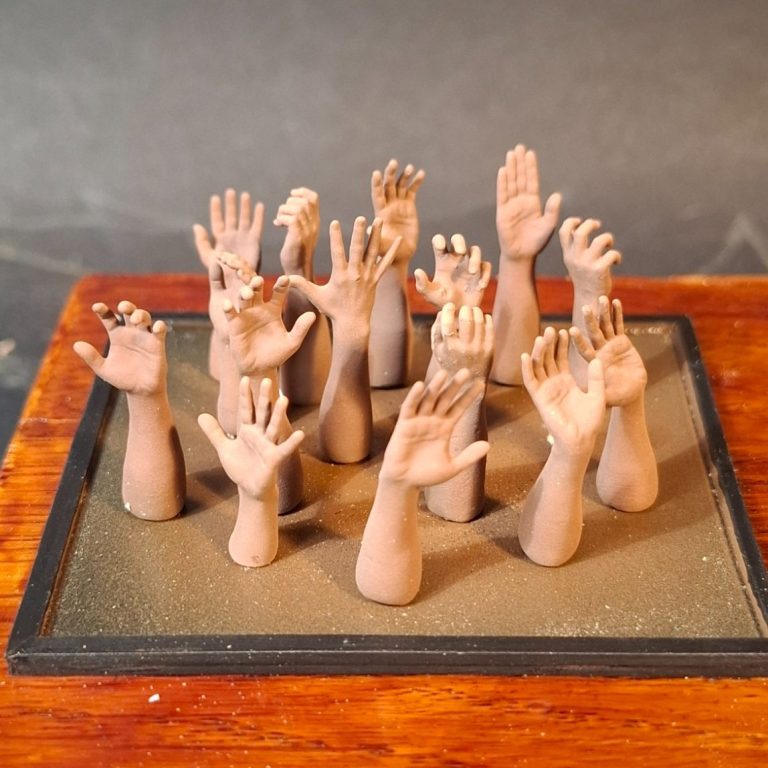
Photo #4 and the hands have been airbrushed with Nato Brown from the Tamiya range, and then a second layer added with a 50:50 mix of Tamiya Flesh and the Nato Brown from above to offer up some highlights.
At this point the hands are test fitted in position, the base frame is made from plasticard and has been painted with the same colours as the hands, misting the central area with the lighter colour and then the outer frame painted with GW Chaos Black ( YES ! I found a pot for sale at a Warboot tabletop sale at Element Games…… I even got a pot of Skull White too ! )
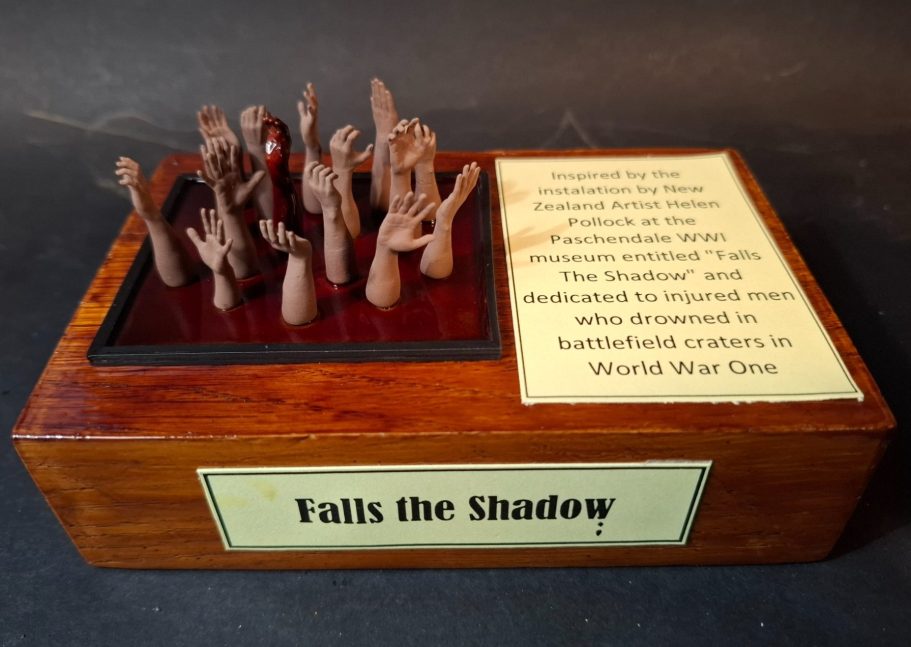
I used a piece of Butcher’s block solid Oak for the plinth, varnishing this with some Mahogany stain, and fastening the base frame to that.
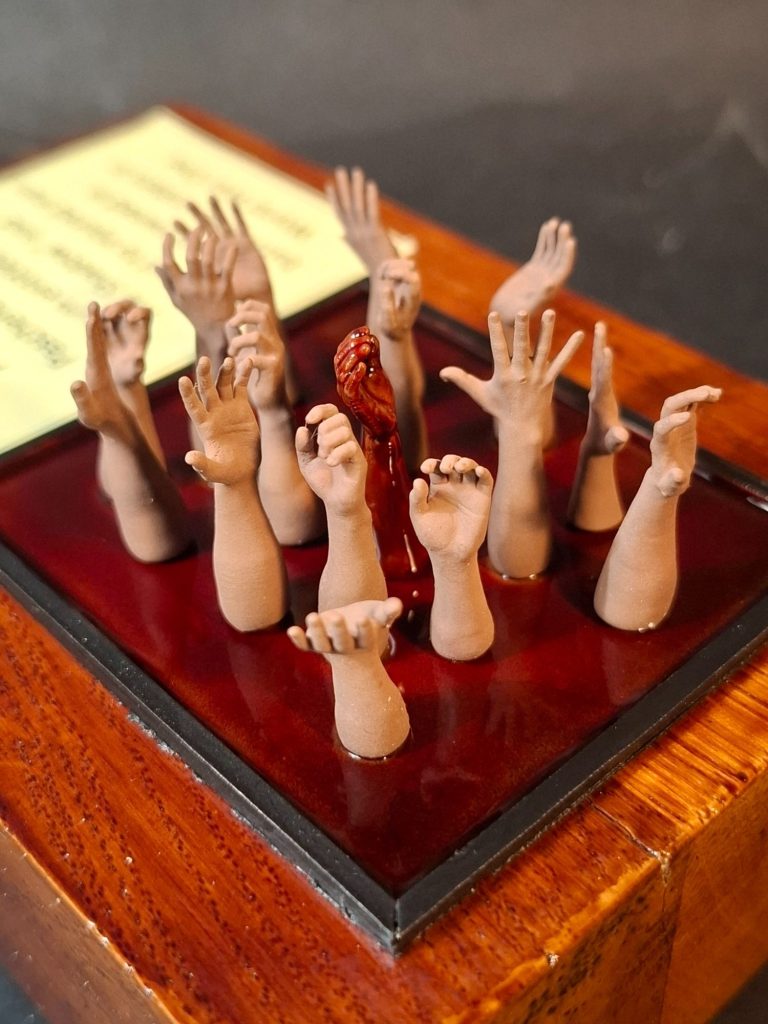
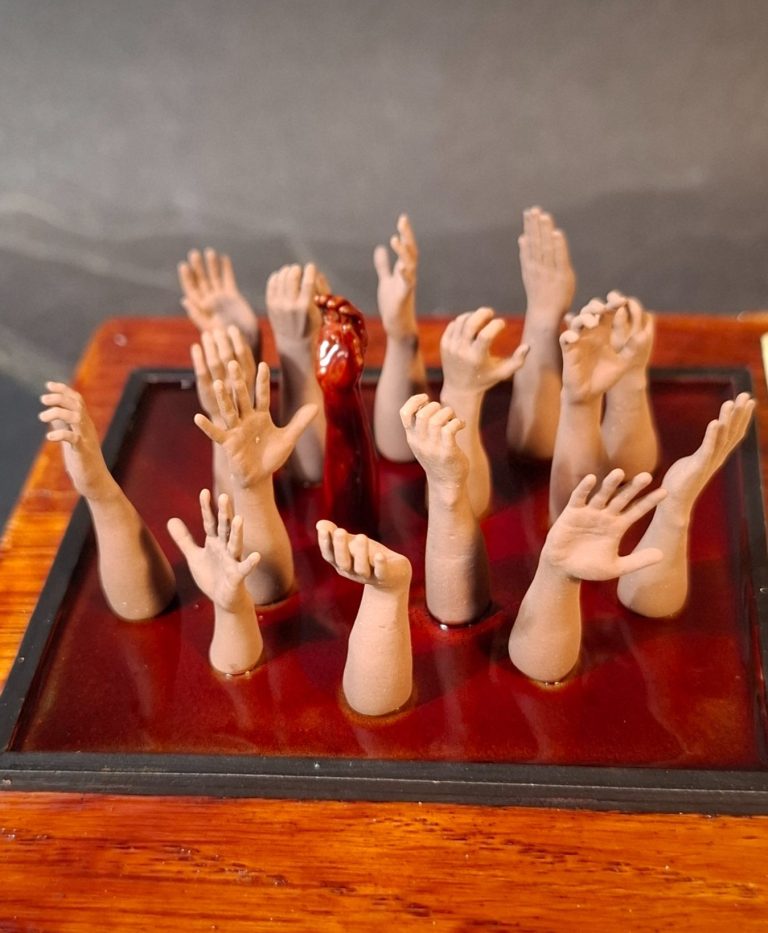
Photos #5, #6 and #7 show the finished model, the two nameplates are print-outs, and although the hands are probably in slightly different positions to the previous shot, it is the same set fastened in place.
After the glue had cured, I added a coat of Mahogany Varnish to the inner section of the base frame to give a gloss finish, similar to the effect on the Fall the Shadow installation and added my own twist to the model.
The film Schindler’s List is one of my favourite films, and there is one “effect” used in it – the black and white scene with the little girl in the red coat – which is very effective and draws the focus of the viewer.
I thought I’d try something similar and painted the central hand with the same varnish as on the base, hopefully making it separate from the other hands, and maybe giving the illusion that it is freshly rising from the surface of the mud…..
I’m not sure that it works, although I think a red coloured hand would have been too much, but it does separate the central hand form the rest.
Final thoughts.
Whilst I’m pleased with the model, and it has invited some amount of comment when taken and displayed at the Bolton Model Show, it’s still relatively small.
I’ve bought some 1/6th scale hands, although only two of them will be useable, and I’ll have to cast copies of them to make up the number needed for the new, improved model.
I’ve bought some 1/6th scale hands, although only two of them will be useable, and I’ll have to cast copies of them to make up the number needed for the new, improved model.
Is the model provocative ?
I hope so, I honestly do.
It’s there to make you think…. The original certainly did that with me.
Here were my thoughts, and I should think that I won’t be on my own.
There were a lot of men went off to fight in World War One. I’m including all nations in that comment, not just “Our Side”
Both my grandfathers fought in WWI, but my paternal Grandfather badly injured in the upper leg and fell, unable to get back up in no-mans-land. Still alive, but very much in pain.
A large calibre bullet, I hazard a guess that it would be a German machine gun, had hit him, and ricocheted off the coins in a purse he was carrying in his pocket, causing ( I should think ) a very nasty wound. He fell on the spot, and I take it he must have crawled for shelter into a nearby crater.
He was stranded, and it was only due to a friend coming out during a cease-fire, finding my grandfather and helping him back to our lines, that he lived to tell the tale.
Had this not happened, had this friend not managed to “bring my grandfather home” then he may well have died out in no-mans-land.
OK, so, “my grandfather died in the War”. I’d not be on my own making that comment, but…..
But that would mean that my father would not have been conceived and then born in 1927, Therefore I wouldn’t have begun life in 1965, my son wouldn’t have been brought into existence in 1993 and my grandson would not have been born in 2023.
The loss of one man, just one man in the vast amount killed, wipes out four following generations that I’m aware of to the present, and how many generations in the future.
That is one of the trains of thought that travelled thought my mind when I saw the installation, and one of the reasons, that it affected me so much.
I congratulate Helen Pollock on her sculpture, and I hope that it stirred the thoughts in many, if not all who have beheld it at the Passchendale museum.
As an aside, the title “Falls the Shadow” is a phrase taken from T.S. Elliot’s poem “the Hollow Men”, representing paralysis and doubt, the inability to act and the gap between desire and fulfilment.
It is the despair of human limitation.
In Addition
So, 1/6th hands he said….
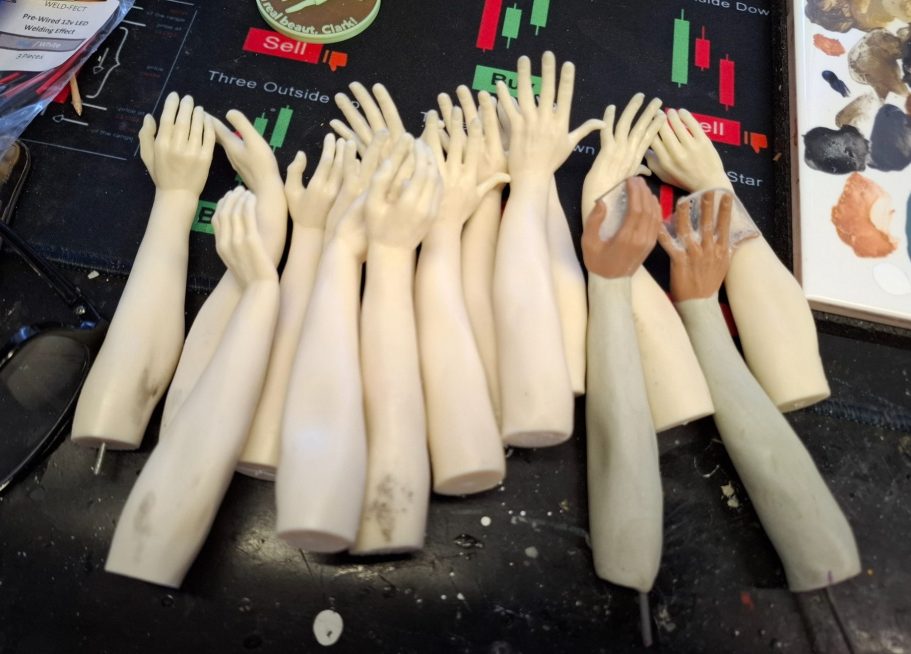
Action Man hands, or that scale at least.
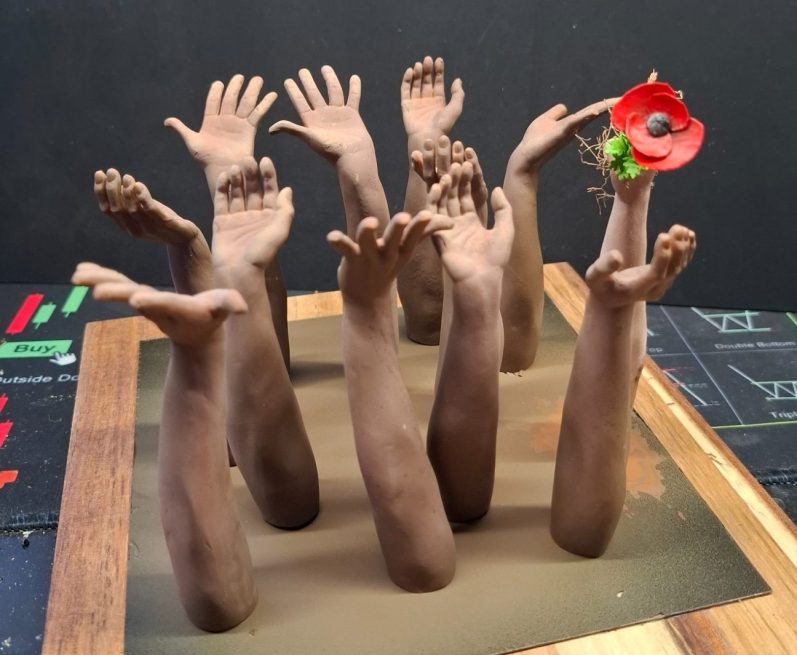
Photo #8 – A show of hands please.
So although I got hold of a couple of sets of assorted hands, I wanted a particular pose. Most of the hands available are for gripping something – a gun usually – but I wanted open, splayed fingers to more accurately recreate Ms Pollock’s sculpture.
Fortunately, within the sets I got were a right and left hand with open enough aspect to be useable, and so all I had to do was fasten a long rite into each wrist socket and sculpt an elongated arm.
The full sized installation has very long arms in comparison to the hands, and again I tried to show this in my recreation, in this shot the two “original” arms are the ones with the flesh coloured hands, the rest are castings I made from those two.
To get the fingers to cast properly I glued some stretched sprue across the finger tips, and then used wood glue that had begun to thicken, to stretch a web across the tirangle formed by the sprue and two fingers.
This was left to cure, and then a second layer of wood glue added to reinforce the initial application.
Photo #9. As with the initial reproduction, I wanted to make an addition of my own, and to mark the men who fell, but also to remember those brave enough to go out and find comrades, I thought an appropriate addition would be a hand gripping a poppy.
I had plenty of spare hands, and used one, as shown, to grip a section of plant root, and also a piece of wire with the scratch built poppy.
The poppy is a piece of thick wire, some carefully cut petals and some leaves from an appropriately shaped leaf punch.
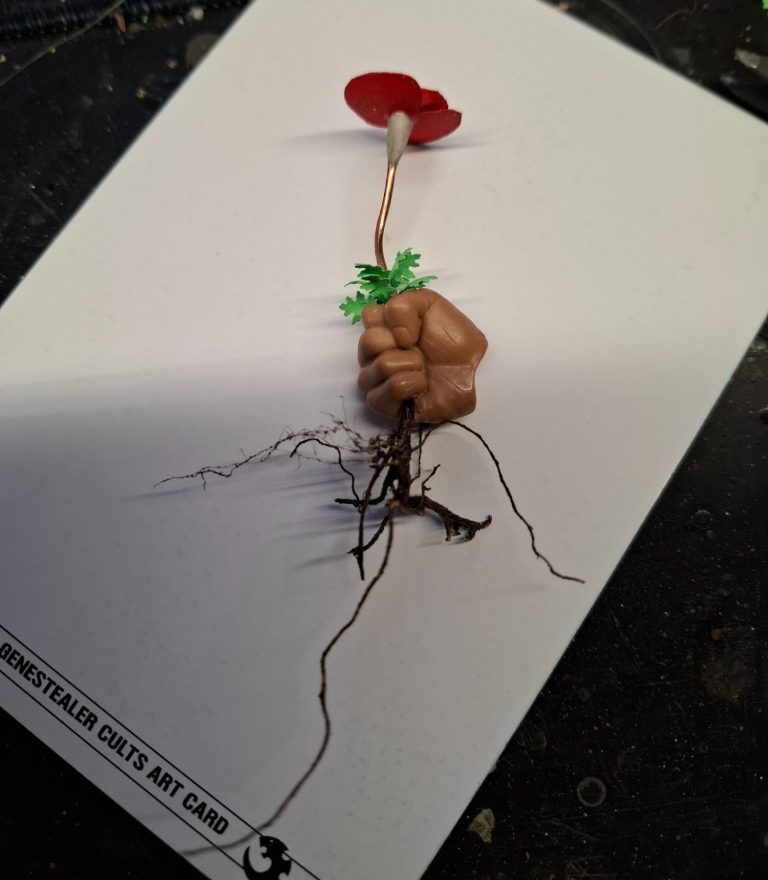
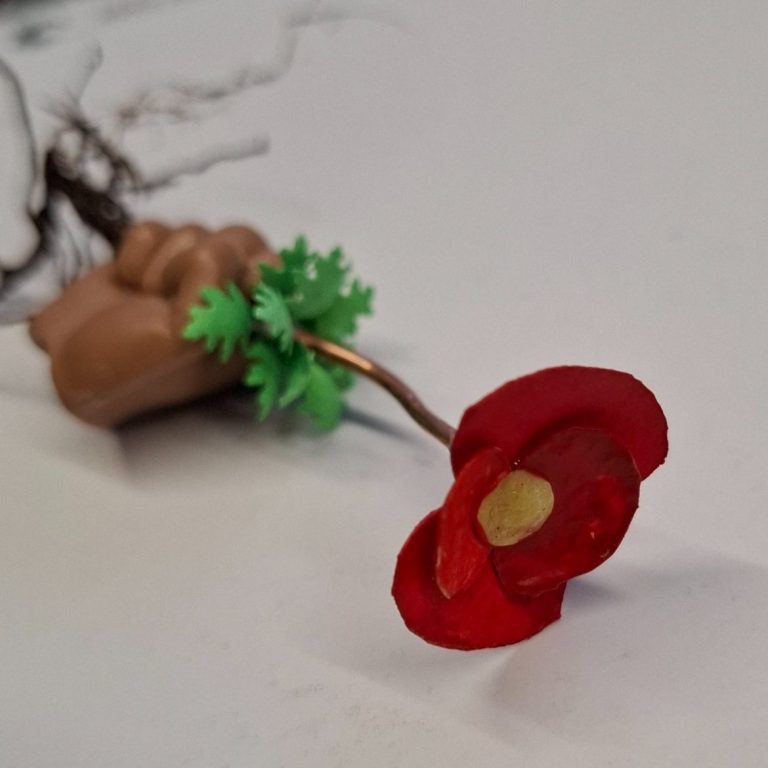
A blob of putty was used to make the stem thicker just below the flower head.
Photo #10, the petals are figure 8 shaped pieces of paper, burnished slightly with a ball shaped sculpting tool on one side to make the concave shape, and a small ball of putty flattened at the centre to form the pollen rich central stamens.
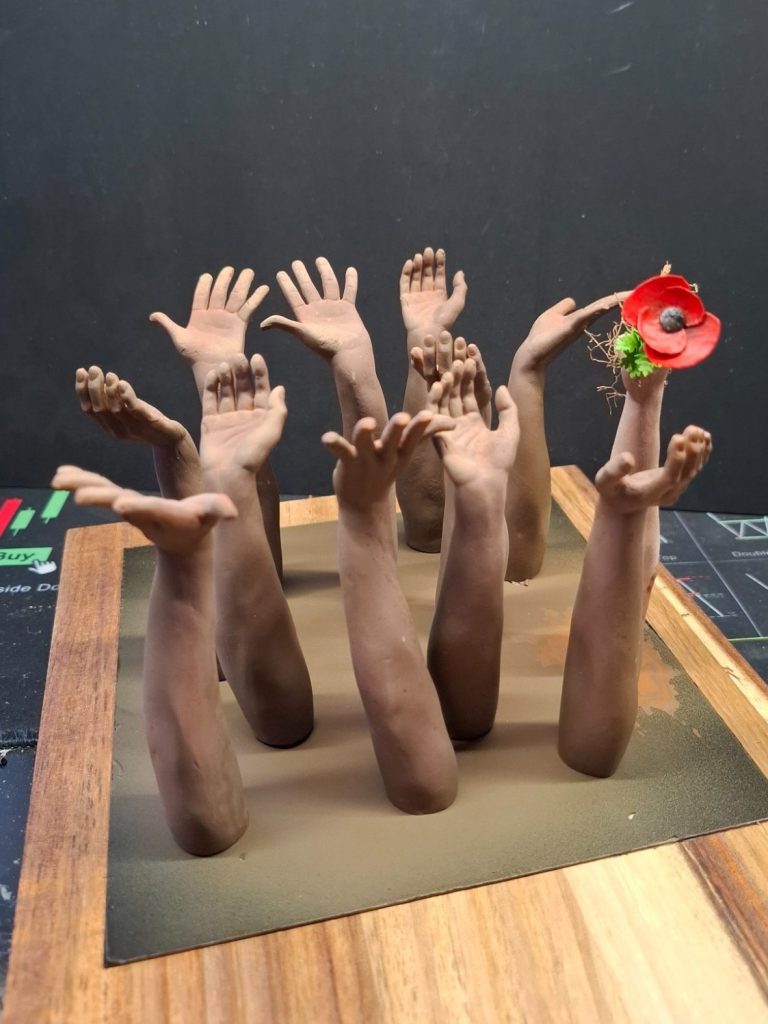
Photos #11 and #12 show the arms located on a section of plasticard that has been sprayed with brown primer and then some black primer lightly dusted around the edges.
Once the arms have settled in place, and the glue has cured fully, then I’ll add some gloss varnish to the square of plasticard.
I’ll also type out an explanation and position that at the side of the model – I chose a particularly large plinth in order to make room for that – which will detail the purpose of the original installation, and of course name Helen Pollock as the originator.
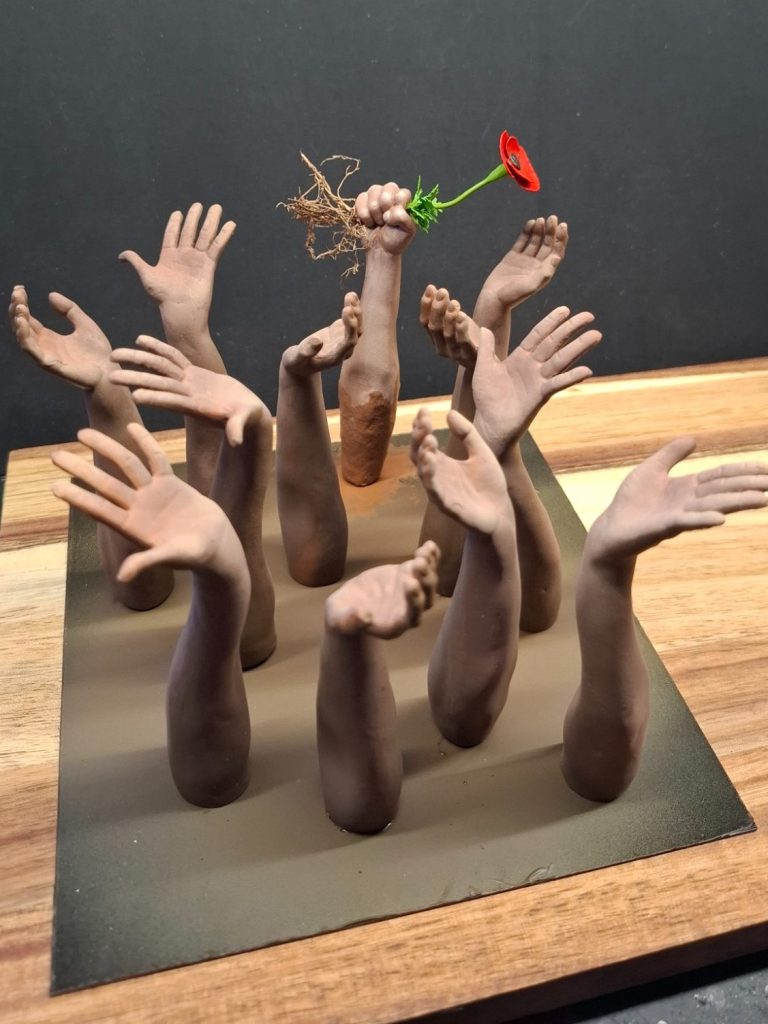
Photo #13. The arm holding the poppy needed to be different. It’s my addition to the piece and I wanted it to separate it somewhat from the rest of the arms, whilst still having it as part of the whole.
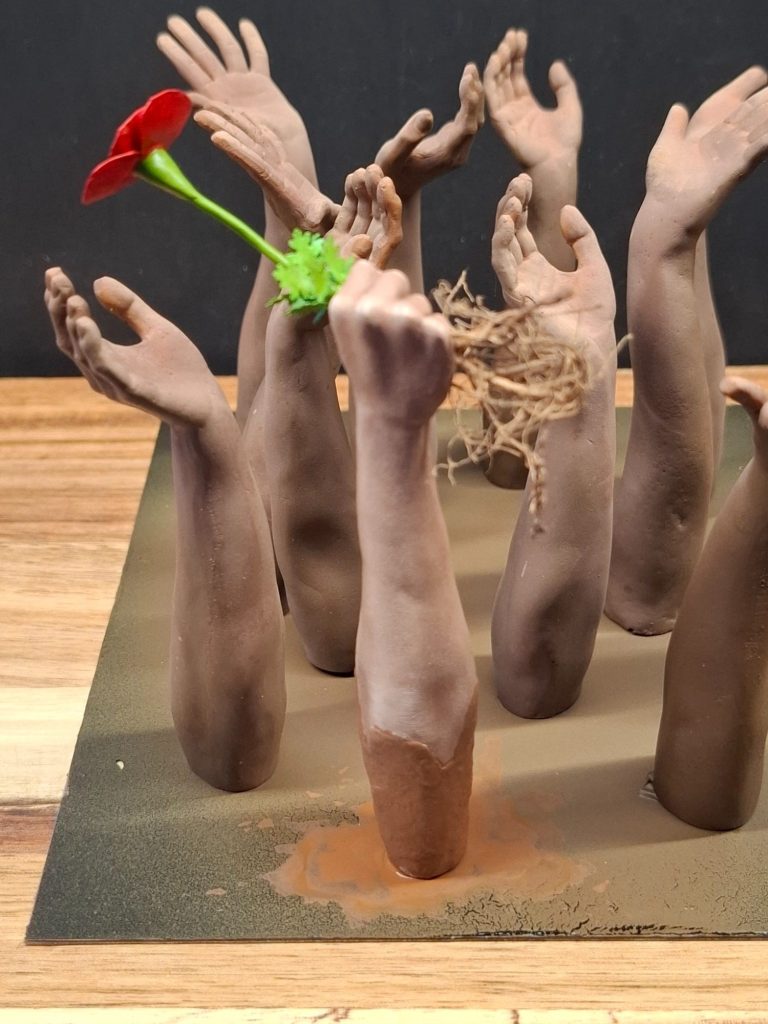
To do this, I thought that whilst the arms were painted with the brown primer and then a small amount of a dark flesh colour applied to highlight them with an airbrush, the arm with the poppy was painted a realistic flesh colour, and to make it appear to be rising from the mud I added several layers of liquid paper to the lower section, giving a rough texture. This was them painted in a different brown, with the parch of the groundwork painted with the same MP Brown colour, ant the edges of it made uneven, like the hand had erupted from the muddy base.
OK, there’s only mud on the lower section of the arm, but I wanted the flesh colour of the hand and forearm to be easily visible, so artistic license prevails.
Final, final words.
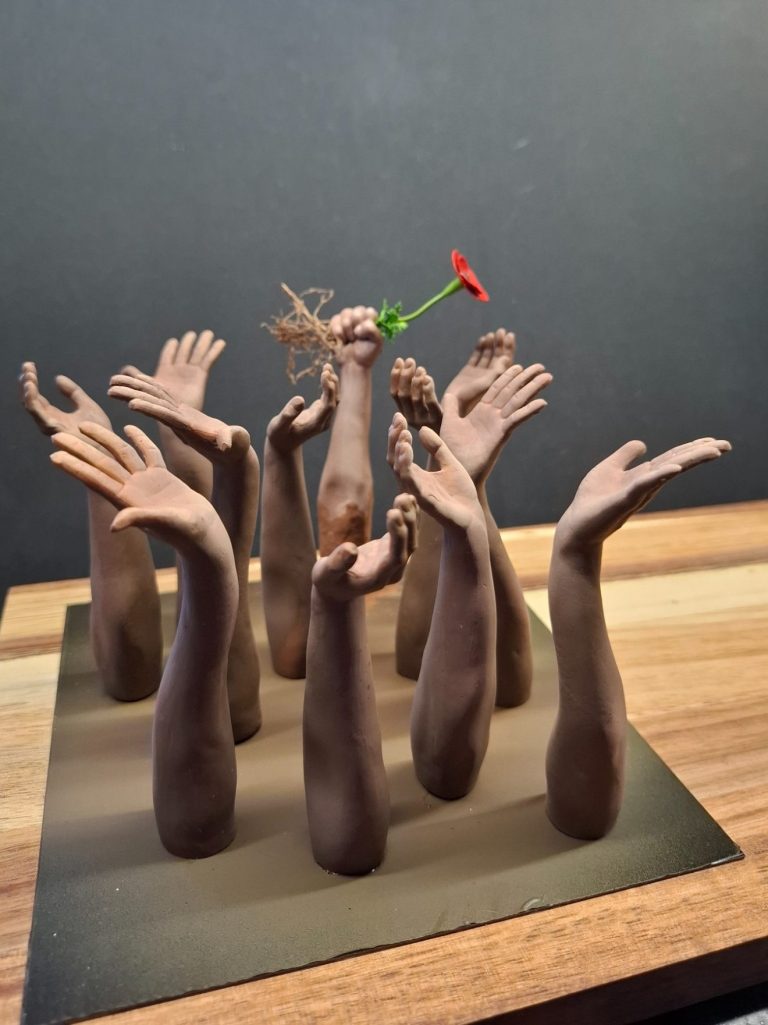
So I’m happier with the second version of this, I think it has more impact, and I’ve translated ( OK Google did it for me ) the text I’ve added into Dutch, French, Italian and German and Polish for when / if this is taken to any international shows.
The original installation, as I’ve previously mentioned, was very thought provoking for me and the guys I visited Passchendale museum with, hopefully this larger version. Although tiny in comparison to the original, has a little more impact than the 1/24th scale one.
This larger one is more accurate to the original too, the hands being in the correct pose, and my inclusion of the poppy wielding one, marks my deepest respect for the combatants, none of whom probably wanted to be on those front lines, but would much rather have been safe at home with their families - no matter how much national pride they possessed.